Category: Jumani Farm House

Stories, updates, and reflections from the Jumanji Farmhouse, our historic family gathering place and restoration project. This category includes farmhouse history, restoration progress, family gatherings, property updates, and the meaning behind preserving a home built to last.

  • Ceiling Demo, Hidden Surprises, and What’s Coming Next at Jumanji Historic Farmhouse

    The latest Jumanji Historic Farmhouse video is up, and this one takes us back inside the house for more ceiling demo, more investigation, and more surprises from a very old building that still has plenty to say.

    In this episode, we open up part of the ceiling, continue chasing the source of an old leak, check progress in the entryway, and look at the area where water had been making its way down into the bathroom ceiling and basement. After a long stretch of wondering what was happening behind the walls and overhead, it is good to finally start seeing answers.

    Of course, no old farmhouse project would be complete without a few discoveries along the way. So far, the restoration tally includes 11 snake skins, 11 raccoons, and 11 bats removed from the house. Yes, you read that right.

    We also look at what is coming next. The patio terrace demo is underway; we are getting closer to exposing more of the old Sears and Roebuck block, and we are continuing the work of preparing the farmhouse for future guests. There are still plenty of messy, dusty, surprising steps ahead — but every layer we remove helps us understand the house better.

    This old place has survived a lot. Little by little, we are uncovering its story and bringing it back to life.

    Watch the video here:
    https://youtu.be/Ujky2GVg7DI?si=89GY1f79su0PYqS

  • Why Old Things Still Call to Us

    There is something about an old farmhouse that never really leaves you. It gets in your bones somehow. Maybe it is the sound of the wind rolling across the fields, or the smell of an old barn when the weather starts to turn. Maybe it is those creaky floors, cold bedrooms, dusty corners, and a hundred little things you did not think much about at the time, but now I’d give anything to stand there for just one more minute.

    The Farmhouse, the Barn, and the Feeling of Home

    Growing up on a Midwestern farm in Indiana, the seasons did not just change on the calendar. They changed how you lived, whether you were ready or not. Winters could be bitter cold, especially in an old farmhouse where the upstairs had no heat, and you learned real quick that blankets were not decorative. Spring brought the smell of fresh dirt, diesel, cut grass, and farming starting up again, which sounds romantic now, but at the time mostly meant somebody was about to put you to work. And on a farm, “work” could mean anything from shoveling horse poop, cow poop, or pig poop, to feeding bucket calves before you even got your own dinner, which seemed unfair at the time but probably built character, or at least resentment with a good work ethic.

    Summer meant big open lawns where we could play baseball in the front yard or fly U-control airplanes in wide circles until we were dizzy enough to fall over, which was apparently considered entertainment before we knew better. It meant baling hay, too, which we all figured was the required conditioning program for fall football when school started back up. Nobody called it training. It was just something everyone did, usually while sweating through your shirt and wondering why hay had to be so personally offensive. Then there was building fence and learning to use those blankety-blank wire fence-making pliers that seemed designed by someone who had never liked children. Hot sticky nights meant hoping that old box fan in the window kept spinning, because air conditioning was something other people had, probably rich people, or at least people smarter than us. Fall brought color, cooler evenings, gatherings, Halloween parties, and later Christmas parties with family crowded together in the house or the barn. Our problems seemed big to us then, because that is how problems work when you are standing right in the middle of them. But looking back, they came from a simpler place and time. Not perfect. Not easy. Just less complicated.

    It was the time before texting, group chats, and everybody being half-distracted by a glowing little rectangle, when people simply got together. Family, friends, neighbors, uncles, parents, kids—everyone showed up, and somehow there was always room for one more, even if that meant another folding chair, another paper plate, or somebody sitting where they probably should not have been sitting. That old place had a way of making everyone feel welcome. Sometimes it was a Halloween party. Sometimes it was Christmas. Sometimes it was just because that is what people did. There were ghost stories, food and drinks, bobbing for apples, games, laughter, and enough good-natured chaos to keep things interesting. My parents would deck out the barn, and my uncles would do their part to scare the daylights out of us, which they enjoyed a little too much if we are being honest. It was spooky, yes, but it was also warm. It was community. It was belonging. And nobody had to send a calendar invite, which may have been the greatest blessing of all.

    I suppose memories like that are what taught me to look at antiques a little differently. When you grow up around barns, tools, weathered wood, patched-up equipment, and things that had to be fixed because buying new was not always the first option, you learn that age does not always mean useless. Sometimes age means it has already proven itself.

    Those things sink in deeper than you realize. At the time, you are just trying to get through chores, school, sports, weather, and whatever your parents told you to do next. You do not stand there thinking, “Well, this will make a nice memory someday.” You are usually too busy being sweaty, cold, hungry, annoyed, or convinced you are being mistreated by the entire adult population. But later, after life has stretched out a little and taken you down roads you never expected, those same moments come back with a softness you did not know they would have.

    Why We Are Drawn to Old Things

    I think that is part of why antiques still call to us. An antique is not just a chair, a table, a sign, a tool, a dish, or some farm piece that somebody dragged out of a barn and dusted off. It is proof that somebody lived. Somebody used it. Somebody carried it, fixed it, cussed at it, treasured it, or passed it along. It belonged to a story before it ever found its way to us.

    That is the thing about antiques. The scratches, dents, worn handles, faded paint, and repairs are not really flaws. They are the good stuff. A brand-new thing may be shiny, but it has not survived anything yet. A well-worn piece has been through moving days, family dinners, muddy boots, hard winters, kids being kids, and somebody saying, “Hey! Don’t throw that away. We might need it someday.” Around my family, that sentence could apparently justify keeping almost anything, but every now and then they were right.

    That is one of the things I appreciate about National Rd. Antique Mall. It gives antiques a place to be seen again, and it gives people a place to wander through pieces of the past without having to explain why they stopped in front of a cabinet, a farm tool, a sign, or a stack of dishes that looked like junk to somebody else but meant something to them. People may come in looking for a certain item, but often they leave with something less expected: a feeling.

    I have watched people walk through the aisles and suddenly stop, not because something is expensive or rare, but because it hit a memory they were not expecting. Maybe it is an old mixing bowl like one their mother used, a tool that looks like it came from their dad’s workbench, a toy they had not thought about in fifty years, a sign from a business long gone, or a piece of furniture that feels like Sunday dinner at somebody’s house. You can see it happen. Their faces change a little. For just a second, they are not standing in a mall at all. They are back in a kitchen, a barn, a garage, a church basement, or a front porch somewhere. Maybe they hear Dad swearing under his breath while fixing something that should have been thrown away, but somehow kept going another ten years. That is the kind of memory that may have slipped away, but never really left them.

    That is what memory does. It does not always announce itself. Sometimes it sneaks up on you in the shape of a rusty lunchbox, a wooden crate, a quilt, a church pew, or a piece of farm equipment you swore you never wanted to see again. Then all at once, you remember a voice, a room, a smell, a laugh, a meal, or somebody who has been gone longer than you want to admit. That can hit a person harder than expected, right there between two booths and a price tag.

    The Comfort of Memory

    Maybe that is the real attraction. Antiques remind us that life was not always easy, but it was often rich in ways we did not understand at the time. A cold farmhouse could still be full of warmth. A barn could become a haunted adventure. A summer night with a box fan humming in the window could feel like survival, and somehow still become a sweet memory later. Even the chores, the noise, the dust, and the things we complained about can turn tender when enough years get between us and them. That is the funny thing about time. It takes the hard edges off some things and leaves the good feeling behind.

    When I walk through the farmhouse or the mall, I do not just see age. Memories of times long forgotten come flooding back. I see hands. I see seasons. I see families, work, laughter, faith, hardship, holidays, and home. I see things that were built, used, repaired, and kept because people did not throw everything away the second it got scratched. Imagine that. I see reminders that the past still has something to say if we are willing to slow down and listen.

    That is also why the old farmhouse and the antique mall feel connected to me. One is a place I am trying to restore, and the other is full of things people saved, rescued, hauled, repaired, and refused to let disappear. Both are really about the same thing: giving the past another chance to speak. Not everything old is worn out. Some things are just waiting for somebody to understand why they mattered.

    That is why antiques still call to me. I have traveled a long road myself, and it has taken me farther from that old Indiana farm than I ever imagined when I was a kid running across the front lawn, complaining about chores, or trying not to freeze upstairs in that farmhouse. Life has a way of moving you along. You grow older, build a family, carry responsibilities, lose people along the way you wish you could talk to again, and celebrate blessings you never saw coming. Then one day you are standing in the old farmhouse, or walking through National Rd. Antique Mall, and you see an old table, a worn farm tool, a kitchen bowl, a wooden chair, or something that looks like it came out of a barn you once knew, and it brings you back. For a moment, I am not thinking about the noise, hurry, and general nonsense of today. I am back in that simpler place and time, where people showed up, where everyone was welcome, where family and faith still held things together even when the house was cold, and the work was hard. Those antiques remind me that my story did not begin yesterday. They are little anchors, tying me back to the people, places, and memories that helped make me who I am.

    Follow along with us on our YouTube Channel

    (1) Jumanji Historic Farmhouse – YouTube
  • Jumanji Farmhouse: Side Entry and a Hidden Discovery

    Every old house has a few secrets tucked away under paint, plaster, trim, dust, and time. At Jumanji Historic Farmhouse, we keep finding them one layer at a time.

    In this video, we are working around the side entry and the basement door, removing old layers of paint and getting a better look at what the original woodwork may have looked like. Inspector Vader, our Welsh Terrier, makes an appearance as usual, supervising the work and making sure we do not miss anything important.

    One of the most interesting discoveries in this part of the house is the faux wood graining. Under the later coats of paint, we are finding evidence that much of the main-floor woodwork was originally finished to look like oak. The actual wood appears to be mostly poplar, which was commonly used because it was available, workable, and less expensive than high-grade hardwood. But with skill, paint, glaze, brushes, combs, and a good eye, a decorative painter could turn ordinary poplar into something that looked like beautiful oak.

    Faux wood graining was a popular decorative painting technique in the 1800s and into the early 1900s. It allowed homeowners to enjoy the look of more expensive woods—oak, walnut, mahogany, and others—without the cost of using those woods throughout the house. The technique showed up in homes, churches, public buildings, and furniture. It was not just “fake wood.” Done well, it was craftsmanship. It was artistry. It was a way of making something plain look warm, rich, and refined.

    I became especially interested in faux finishing during our years in Utah. Many Latter-day Saint pioneer homes and buildings used beautiful painted finishes. Out West, hardwood from the East was harder to come by, and many families built with the wood they had available—often pine or other softer woods. Skilled painters could then use faux graining to give those surfaces the appearance of finer hardwood. Some of that work is absolutely gorgeous. It is one of those old skills that deserve more appreciation than they get.

    Finding that same kind of work here at Jumanji Farmhouse gives the house another layer of personality. It reminds me that the people who built and finished this place cared about how it felt inside. They were not just putting up boards and plaster. They were trying to create beauty. They were taking what they had and making it better.

    There is also plaster visible in the background of this video, which is another reminder of how these old houses were built. Before drywall, plaster was the standard interior wall and ceiling finish. It took more labor, more skill, and more time. Like faux graining, it tells us something about the hands that shaped this house long before we came along.

    In this project, we use a paint stripper called Peel and Strip to remove layers from the basement door. And yes, apparently saying “Peel and Strip” out loud caused a little confusion for someone who thought I was making a political statement. Oh boy. No politics here—just old paint, old wood, and a product name that sounds more dramatic than it really is.

    As the paint comes off, the original finish begins to show itself. That is one of my favorite parts of restoration. You start out thinking you are just cleaning up a door, and then suddenly you are looking at the decisions someone made 150 years ago. A brushstroke, a color choice, a grain pattern, a piece of poplar made to look like oak—all of it becomes a conversation with the past.

    This is why we keep working on Jumanji Farmhouse. It is dusty, slow, expensive, frustrating, and occasionally full of surprises we did not request. But every once in a while, the house gives us something beautiful back.

    This side entry and basement door are one of those moments.

    Watch the video here:
    Jumanji Farmhouse: Side entry a hidden discovery.

  • The House That Was Left Untouched

    Shorts playlist: To understand where this restoration journey began, it is best to view the shorts from oldest to newest. The early videos help show the condition of the property when we first purchased it, including the overgrowth, neglected structures, rough edges, and the long road ahead as we began bringing the Jumanji Farmhouse back to life. : Channel content – YouTube Studio

    When we first looked at the Jumanji Farmhouse, there was no pretending it was an easy project. The house was a pile of foreseen problems, hidden problems, and two-hundred-year-old issues waiting for someone patient enough—or stubborn enough—to face them. Old houses do not give up their secrets all at once. They reveal them board by board, stone by stone, and problem by problem.

    And yet, one of the brightest and most inspiring discoveries is that so much of the house appears to be untouched. Not untouched in the sense that it was perfect, because it certainly was not. Untouched in the sense that parts of it were left the way they had been for generations. In a world where old homes are often stripped, modernized, covered over, or erased beyond recognition, this farmhouse still carries clues from the people who built it and lived here long before us.

    The house may once have been a four-square home with a center hallway, a layout that appears to have been changed or removed perhaps one hundred to one hundred twenty years ago. That kind of alteration tells its own story. A house that has stood for roughly two centuries is not frozen in time; it adapts as families change, needs change, and generations make the place work for their lives. Even when walls move, doorways shift, or hallways disappear, the bones of the original home often continue speaking.

    Many of the construction details appear consistent with typical Quaker building traditions: practical, sturdy, modest, and built with purpose rather than show. That matters to us because the early owners were Quakers and abolitionists, and the property sits in a region where Underground Railroad history was very present. We are careful not to claim more than we can prove, but we do believe the architecture and history are worth studying closely and preserving respectfully.

    One especially unique feature is the full walk-out basement. It is not simply a cellar tucked under the house. It includes an oversized cooking fireplace, complete with old smoke stains that still mark where fire once worked against the brick and stone. Standing there, it is not hard to imagine the fireplace once serving as more than a place to cook. It may have helped heat the upper floor through radiant heat, warming the house from below during cold seasons.

    Those smoke stains are more than discoloration. They are evidence of use, labor, meals, warmth, and survival. They remind us that this was not originally a decorative farmhouse. It was a working home. People cooked there, worked there, endured the weather there, raised families there, and made do with what they had. That kind of history is not something we want to erase with drywall and paint. It is something we want to understand.

    Another remarkable remnant is the old well, where signs of a terracotta dome cover still remain. Details like that stop you in your tracks. They turn a project into a conversation with the past. You begin asking questions: Who drew water there? How many families depended on it? What did the property look like when the well was still in daily use? How much of the story is still waiting just beneath the surface?

    That is the strange blessing of the Jumanji Farmhouse. Yes, it came with problems—many of them obvious, many of them expensive, and many of them older than anyone alive today. But it also came with authenticity. It came with untouched features, old construction clues, a full walk-out basement, a fireplace still bearing its smoke, traces of an old well, and enough original character to make the work feel less like renovation and more like stewardship.

    Paul Fowler Author

  • The Story Behind the Jumanji Farmhouse

    Related video: https://youtu.be/iOqsIa2_zow

    The Jumanji Farmhouse is more than an old house. It is a family homestead, a restoration project, a gathering place, and a living reminder that some things are worth saving. When we purchased the property, the beginning was anything but polished. The main barns had collapsed or were in a state of ruin, the land had been let go for roughly forty years, and much of the ground had grown into what I call a “bird poop forest”—trees, brush, and volunteer growth spread by birds and wildlife over decades.

    In the beginning, we truly had no idea how daunting the task was going to be. What looked like a restoration project quickly became a long journey of cleanup, rebuilding, problem-solving, and learning as we went. Thankfully, we have not walked that road alone. Family and friends have helped us along the way, lending a hand, encouragement, equipment, advice, and the kind of support that makes an overwhelming project feel possible one step at a time.

    One of the most memorable parts of that overgrowth has been the hedge apples, also known as Osage orange. There were hundreds—maybe thousands—of them across the property. As a kid, I thought hedge apples were intriguing and almost amazing. As an adult clearing land, repairing tire damage, and feeling the pain of their thorns, I have learned to see them a little differently.

    The history of the home reaches back deep into the early settlement period. We have genealogy and property history connected to the home going back before the original patent deed was signed by President James Monroe in 1821. The original homestead was eighty acres, and the first owners were Quakers and abolitionists. Because Underground Railroad activity was so prevalent in this region, and because of the beliefs and background of those early owners, we believe the property may have a connection to that history as well. That is a story we continue to research with care and respect.

    Some of the barn evidence points even farther back. The nails, framing, and construction techniques suggest late 1700s to early 1800s workmanship, which would be consistent with settlers occupying and improving the land before formally applying for and receiving the homestead patent deed. That possibility makes every weathered board and hand-worked joint feel even more meaningful.

    When we began sharing the Jumanji Historic Farmhouse journey on YouTube, the goal was simple: document the real work of bringing a historic farmhouse and neglected land back to life. The video linked above shows some of those early conditions—the collapsed barns, the overgrowth, the rough edges, and the honest starting point. That includes the beautiful moments, the dusty moments, the unexpected discoveries, and the projects that do not always go according to plan. Old houses and old farms have a way of teaching patience. They also have a way of reminding us that restoration is not just about repair—it is about respect.

    Raised on the farm, I learned early that anything meaningful takes time. You work, you make mistakes, you dust yourself off, and you get back in the saddle. That same lesson applies to farmhouse restoration. Some days bring progress you can see. Other days are spent solving problems nobody will ever notice once the job is done. But both kinds of work matter.

    The Jumanji Farmhouse represents faith, family, heritage, hard work, and the belief that what came before us should not be carelessly forgotten. We hope that by sharing the journey, others will be encouraged to preserve their own family stories, restore what they can, and create places where future generations can gather.

    If you are new here, welcome. Follow along as we restore the Jumanji Farmhouse, uncover its history, work the land, preserve old things with soul, and share the lessons learned along the way.

    Paul Fowler

  • Harvesting Memories: Why Family Roots Run Deep and Eternal

    Harvesting Memories: Why Family Roots Run Deep and Eternal

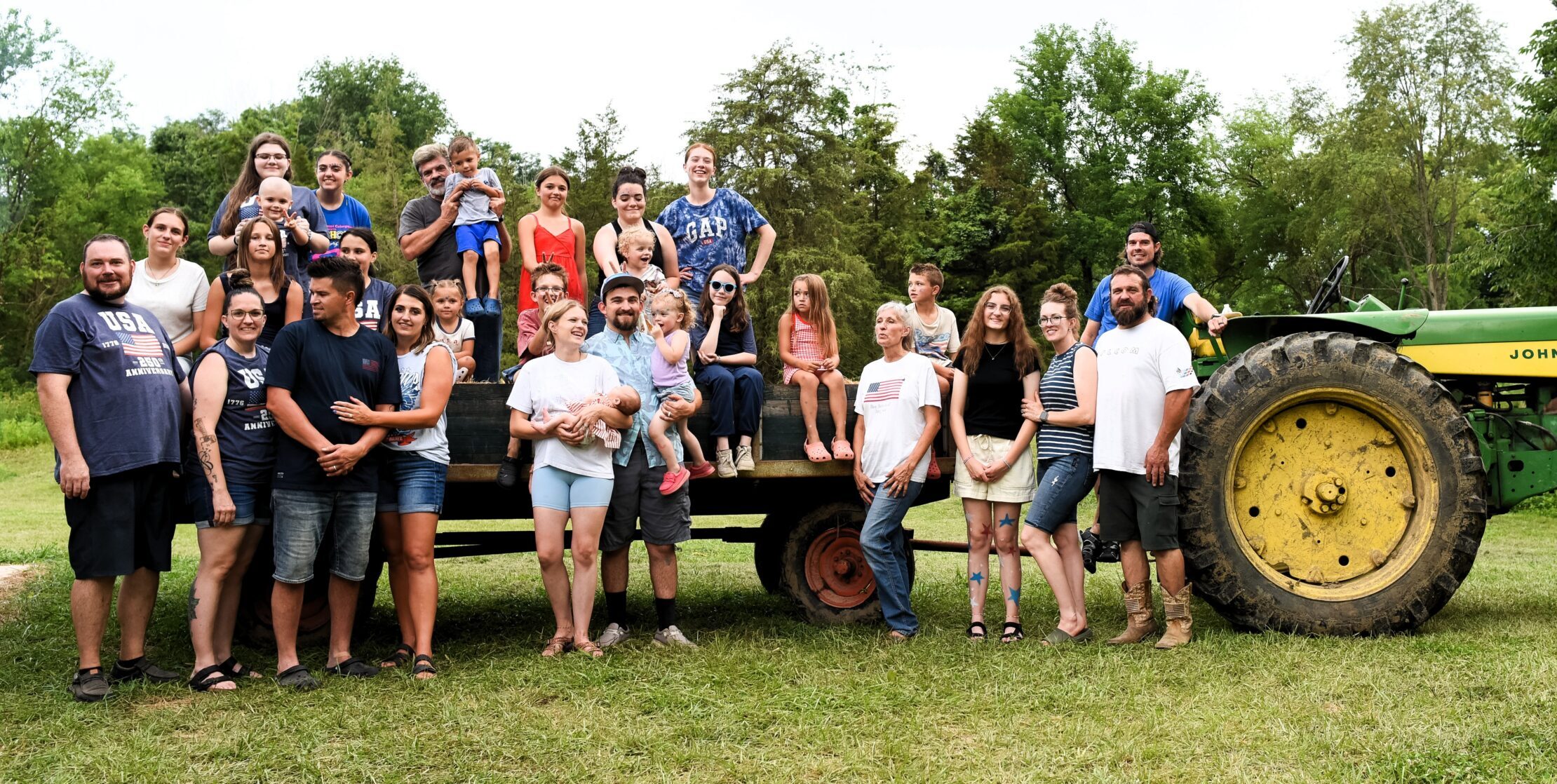
    There is a quiet, sacred magic that happens when a family gathers under the open sky. In a world that constantly pulls us toward speed, noise, distraction, and screens, standing in a green field with the people who share your blood, your history, your faith, and your heart feels like stepping onto holy ground.

    The Jumanji Farmhouse is more than a house. It is our gathering place.

    When I look at this photograph, I don’t just see a group posing for a camera. I see an entire legacy staring back. I can almost hear the soft rustle of the summer leaves, the gentle hum of cicadas in the distance, and the symphony of family life—the sudden, bright laughter of a child, the quiet murmurs of catching up, and the rhythmic creak of the wooden wagon. It is a snapshot of pure, chaotic, yet unhurried togetherness.

    Our family, like the weathered wagon and the tractor beside it, is built to last generations—even eternally.

    As the generations gathered next to it, that John Deere machine has a story; it speaks of a time when life moved at the pace of the seasons, when work was done by hand, and when nothing of value was created without patience and sweat. A classic tractor and a sturdy wagon are built to endure; they survive the elements because they were crafted with a purpose.

    In many ways, our families are the same. We are built on the quiet, steady labor of those who came before us. Every generation stands on the shoulders—and the sacrifices—of the previous one, inheriting a foundation of faith, resilience, and love. The weathering we experience through life’s storms doesn’t weaken us; it gives us character, strength, and a deeper beauty.

    As a Latter-day Saint, family isn’t simply a social unit or a comforting part of this earthly journey. It is the absolute center of our existence. It is the very purpose of creation. Our faith teaches us a profound, beautiful truth: that the relationships we forge in this life are meant to transcend the grave. The bonds we share are not temporary arrangements bound by time; they are designed to last forever.

    When Elijah the Prophet restored the sealing keys to the earth, he promised that the hearts of the fathers would turn to the children, and the hearts of the children to their fathers. Looking at this wagon, you see that promise alive in the flesh. You see it in the tender way an infant is cradled in warm, protective arms. You see it in the bright, unfiltered joy of the teenagers and young adults finding their place in the world. You see it in the steady, weathered presence of the grandparents whose legacy is written in the faces of every soul on that wagon.

    Every face represents a vital link in an unbroken, eternal chain. The laughter shared on the back of a simple wagon and the memories cultivated in the quiet countryside are more than just pleasant passing moments. To me, they are literal glimpses of heaven on earth. They are a physical manifestation of the joy the Savior promised when He spoke of our divine potential.

    Life’s most profound meaning is never found in expensive getaways, material wealth, or the applause of the world. It is found right here—standing on the grass, under the sun, surrounded by the people who know your flaws and love you unconditionally. It is found in realizing that we are part of something much bigger than ourselves.

    This isn’t just a photograph. It is a record of our greatest harvest—our heritage. It is a witness that family, like the weathered wagon and tractor beside us, is built to last through seasons, storms, generations, and, by the grace of God, even eternally.

    Paul Fowler